
A multidisciplinary team conducting data-driven and evidence-based health services research to optimise equitable cancer care that reflects the needs and preferences of people affected by cancer.
Medical research and innovations are accelerating at a rapid pace. The healthcare system needs to swiftly adapt to provide novel approaches for cancer patients.
Led by Professor Gang Chen, the Cancer Health Services Research group is driving value-based transformative improvements across the cancer care continuum, for a sustainable and equitable healthcare system.
The team use real-world data to drive healthcare improvement, using economic evaluation and modelling to provide the economic case for implementing genomics enabled precision care into routine services.
Timely access to effective treatments is vital. We’re working with Health Technology Assessment agencies and governments to guide reimbursement decisions, recommending medicines that balance clinical benefit with cost.
The group has vital links with state and commonwealth health data, as well as clinical registries, to develop a linked population-wide dataset covering individuals with colorectal, lung, breast, prostate, melanoma, and lymphocytic leukaemia cancer diagnoses.

The Cancer Health Services Research group use patient reported outcomes, experiences and preferences to drive more efficient, effective and equitable outcomes for people impacted by cancer.
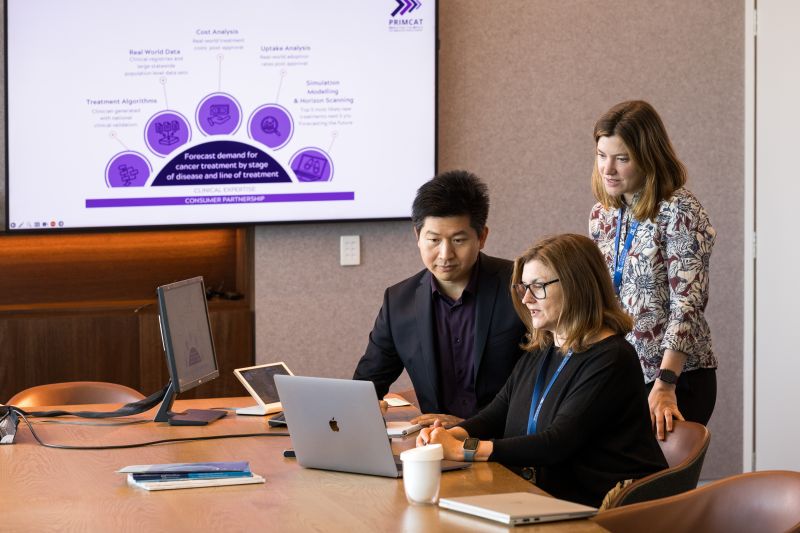
PRIMCAT
This MRFF-funded program has developed a linked population-wide dataset that covers individuals with a specific cancer diagnosis (colorectal, lung, breast, prostate, melanoma, and lymphocytic leukaemia) identified through the Victorian Cancer Registry, for whom their health records across hospital administrative data and PBS and MBS data were linked.
The group is now scoping the expansion of this dataset to encompass all cancer diagnoses, accrue additional data sources, and broaden its ethical scope. This scoping will focus on integrating pathology, genomics/biomarker information, and clinical trial data. It aims to enhance personalised medicine approaches in cancer diagnostics and treatment, as well as enabling the development of comprehensive health economic models.
-
This project focuses on evaluating and finding the optimal timing of WGS implementation for women with rare gynaecological cancers.
-
-
This study aims to create a catalogue for Australian-specific health state utility scores associated with different cancer types, cancer stages, genomic testing, as well as treatment regimes. The output will facilitate a more consistent estimation of benefits for cancer-related health economic evaluation in Australia.
-
-
This project utilised Victorian state-wide population-level administrative datasets to quantify variation in radiotherapy care and to identify referral and retreatment of cancer patients, stratified to investigate the outcomes achieved by vulnerable patient groups, for example CALD and low socio-economic status patients. Analyses included health service utilisation for subgroups of patients and the burden of financial toxicity imposed by out-of-pocket costs (such as travel to treatment).
TAGC Health Economics Platform
The Cancer Health Services Research group lead the Health Economics Platform of The Advanced Genomics Collaboration (TAGC) – the University of Melbourne’s key initiative with industry partner Illumina. The platform analyses TAGC's national and global-scale genomic datasets to provide evidence-based guidance for public policy and investment.
Key studies within the TAGC Health Economics platform include:
- Development of health economic models of liquid biopsies to improve cancer
- Determination of optimal use of diagnostic and molecular testing in blood cancers
- Developing Simulation Models to Support the Implementation of Whole Genome Sequencing
- Health economic evaluation of genomic-based risk stratification for favourable intermediate-risk prostate cancer.


The burden of cancer is substantial and rapidly increasing globally. Health economics and health services research can contribute to the whole cancer control continuum. Professor Gang Chen
Latest News

Our seminars
Watch our seminars on-demand, highlighting our work across the Collaborative Centre for Genomic Cancer Medicine.
Contact and more information
Professor Gang Chen
Melbourne School of Population and Global Health
gangchen@unimelb.edu.au