Nine years to diagnosis
Neuroendocrine tumours are rare cancers that can grow undetected for years, often misdiagnosed as other conditions. A new national research initiative called PLANETARI aims to change how they are found, studied and treated.
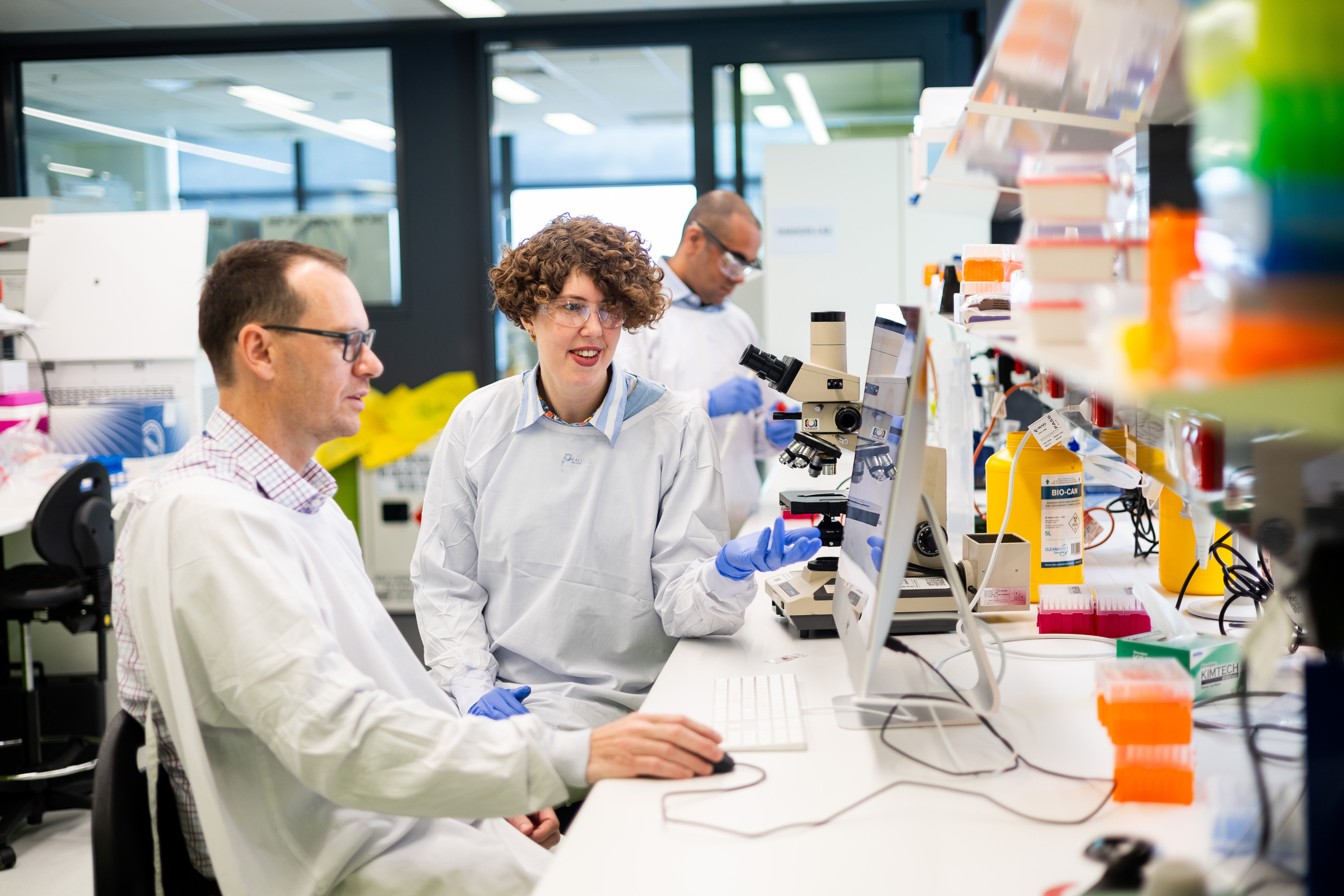
"People with neuroendocrine tumours might come to a place like Peter Mac and hear that they have cancer for the first time, but they've been living with it for years," says Dr Emma Boehm, a NET clinician scientist at the Peter MacCallum Cancer Centre. "They have stories of where they were diagnosed with things like irritable bowel disease, or anxiety, or menopause. But what they had was a cancer that's been growing for years and is now widespread and incurable."
Neuroendocrine tumours (NETs) are cancers that develop in the hormone-producing cells found throughout the body, including the pancreas, gut and lungs. Because they are rare and their symptoms mimic common conditions, patients wait on average more than nine years from first symptoms to diagnosis. Sadly, more than 60 per cent are diagnosed only after the cancer has spread and can no longer be cured.
For years, patients and their families have been leading the call for a coordinated national research effort.
"Those of us with rare cancers don't hope for better treatments from large, traditional clinical trials — these need many patients," says Therese Townsend, who lives with a neuroendocrine tumour. "What we need are clever and innovative ways of gathering and interpreting the data from our many appointments, tests, scans and treatments."
Now, with $3 million from the Australian Government's Medical Research Future Fund, a new initiative is bringing that to life.
PLANETARI brings together researchers and clinicians across six states, led by Associate Professor Richard Tothill from the Collaborative Centre for Genomic Cancer Medicine, a joint venture between The University of Melbourne and Peter MacCallum Cancer Centre. A/Prof Tothill has been a leader in neuroendocrine tumour research for more than 15 years, working to understand the genomics of these rare cancers and translate that into better diagnosis and treatment.
"This is a cancer that is under-recognised and has been historically underfunded for research," he says. "There is a big need."
PLANETARI is spearheaded by A/Prof Tothill and Dr Boehm, bringing together clinical and research expertise across the Centre's partnership between the University of Melbourne and Peter Mac. The broader clinical team at Peter Mac includes Professor Michael Michael and Associate Professor Grace Kong, who co-chair the hospital's Neuroendocrine Tumour Centre of Excellence — one of only two centres outside Europe credentialed by the European Neuroendocrine Tumour Society. PLANETARI was also co-designed with NeuroEndocrine Cancer Australia (NECA), the national patient advocacy organisation.
Starting from scratch
Until now, researching neuroendocrine tumours has meant working largely in isolation. Each team collects its own samples, builds its own records and starts from the ground up.
"Whenever people start to do research on these rare cancers, they're reinventing the wheel every time," Dr Boehm says. "They're having to start from scratch, collect the samples. That puts the research back years, and it limits the scale of the work that can be done."
PLANETARI changes that. It brings together blood and tissue samples from across the country, each linked to detailed clinical records: what the patient was diagnosed with, how they were treated and how they responded. An existing registry of 1,646 patients forms the foundation, with 500 more contributing samples over four years. The model is already being adopted internationally, with partners in Canada.
"Rare cancers require big collaborations just to get the numbers," A/Prof Tothill says. "This is research that bridges between the University of Melbourne and Peter Mac, and more broadly across Australia. It would not be possible without that collaboration."
"PLANETARI will ultimately give us access to new, innovative treatments," Therese says. "The team is working so hard to make our lives fairer and better."
For the first time, researchers will be able to study patterns across hundreds of connected cases rather than handfuls.
A two-year study within PLANETARI, called PLANETARI PRIME, will go further. Fifty patients will have both their tumour and their own DNA tested, looking for genetic changes that could explain why they developed the disease, guide their treatment, and reveal whether family members might carry the same risk.
An initial study at Peter Mac has shown why this matters. More than one in four patients tested carried an inherited genetic change linked to their cancer, yet under current clinical guidelines, most would never have been offered the test. They would never have known, and neither would their families.
More than a decade in the making
A/Prof Tothill had been working in neuroendocrine tumour genomics since 2011, first through a research collaboration at Peter Mac and then, from 2017, as a group leader at the Collaborative Centre for Genomic Cancer Medicine, where he founded the Rare Disease Oncogenomics (RADIO) Laboratory.
Over the nine years since its founding, the lab has established itself as an international leader in the field — applying genomics to rare and diagnostically challenging cancers, developing new diagnostic methods, and working to bring genomic testing into clinical practice.
It is work that depends on the Centre's unique position: a genomics research facility embedded within a cancer hospital, with researchers and clinicians working side by side. For A/Prof Tothill, programs like PLANETARI exemplify what the Centre was built to do — bridging the best of both the University of Melbourne and Peter Mac to tackle problems that neither could solve alone.
"A lot of these missing pieces have been there for a while and no one's really been able to pull it together until now," he says. "That's the really exciting part."
Dr Boehm completed her PhD in the RADIO Lab between 2022 and 2025 while treating NET patients at Peter Mac — working across both sides of the Centre's partnership. Now their collaboration continues, with A/Prof Tothill leading the research program from the Centre and Dr Boehm driving the clinical side at Peter Mac.
"I can see someone in clinic, know that I need their DNA sequenced in a way that is not otherwise available outside of a research context, and have a team of expert scientists report back — these are the things we've found, this is how it might change the way that patient is treated," she says. "Within weeks. It's hugely powerful."
"It exemplifies the partnership between the University of Melbourne and Peter Mac," A/Prof Tothill adds. "It's bridging and bringing the best from both sides together to make big things happen."
Following the patient's lead
While the research capability was building at the Collaborative Centre, a parallel effort was underway. NeuroEndocrine Cancer Australia had built the original patient database that PLANETARI now expands on, securing investment for a registry across five hospitals. PLANETARI broadens that foundation, adding tissue collection and genetic testing to make the data usable for research at national scale.
"NECA laid the groundwork," Dr Boehm says. "We're following where the patient group has led."
"For so long, neuroendocrine cancer research has been poorly funded and outcomes have suffered," says Meredith Cummins, CEO of NeuroEndocrine Cancer Australia. "PLANETARI will change that — for our patients in Australia and ultimately internationally."
What comes next
"We want to identify disease, predict how it will behave, and find the best treatment for each patient," A/Prof Tothill says. "From prevention and early detection through to treatment decisions, PLANETARI will address each of these parts."
"I'm really hopeful that this platform will give clinicians better tests to diagnose these cancers earlier," Dr Boehm says.
PLANETARI will take five years to build in full. For the more than 31,000 Australians living with a neuroendocrine tumour, it represents something that has not existed before: a national research effort built with the patient community, not just for them.
Learn more about the Collaborative Centre’s Rare Disease Oncogenomics (RADIO) Lab →
About PLANETARIPLANETARI is led by A/Prof Richard Tothill (Collaborative Centre for Genomic Cancer Medicine) with chief investigators Dr Emma Boehm (Peter MacCallum Cancer Centre), A/Prof Gabrielle Cehic (Queen Elizabeth Hospital), Dr David Chan (Royal North Shore Hospital), Prof Gang Chen (Collaborative Centre for Genomic Cancer Medicine), Prof Roderick Clifton-Bligh (University of Sydney), Meredith Cummins (NeuroEndocrine Cancer Australia), Dr Nattakorn Dhiantravan (Royal Brisbane and Women's Hospital), Prof Stephen Fox (Peter MacCallum Cancer Centre), Prof Anthony Gill (Royal North Shore Hospital), A/Prof Grace Kong (Peter MacCallum Cancer Centre), Dr Chris Lomma (Fiona Stanley Hospital), Prof Michael Michael (Peter MacCallum Cancer Centre), Prof Nick Pavlakis (Royal North Shore Hospital), and Prof Richard Sinnott (University of Melbourne). The initiative was co-designed with NeuroEndocrine Cancer Australia. PLANETARI is funded by the Australian Government's Medical Research Future Fund. |